A 14-Month Investigation Found Why Crepey Arms Don't Respond to Any Cream
Women over 50 are told to moisturize harder or pay for surgery. A Spokane physician says both miss the real cause, and a $54 plant oil reaches what $190-a-month treatments can't.
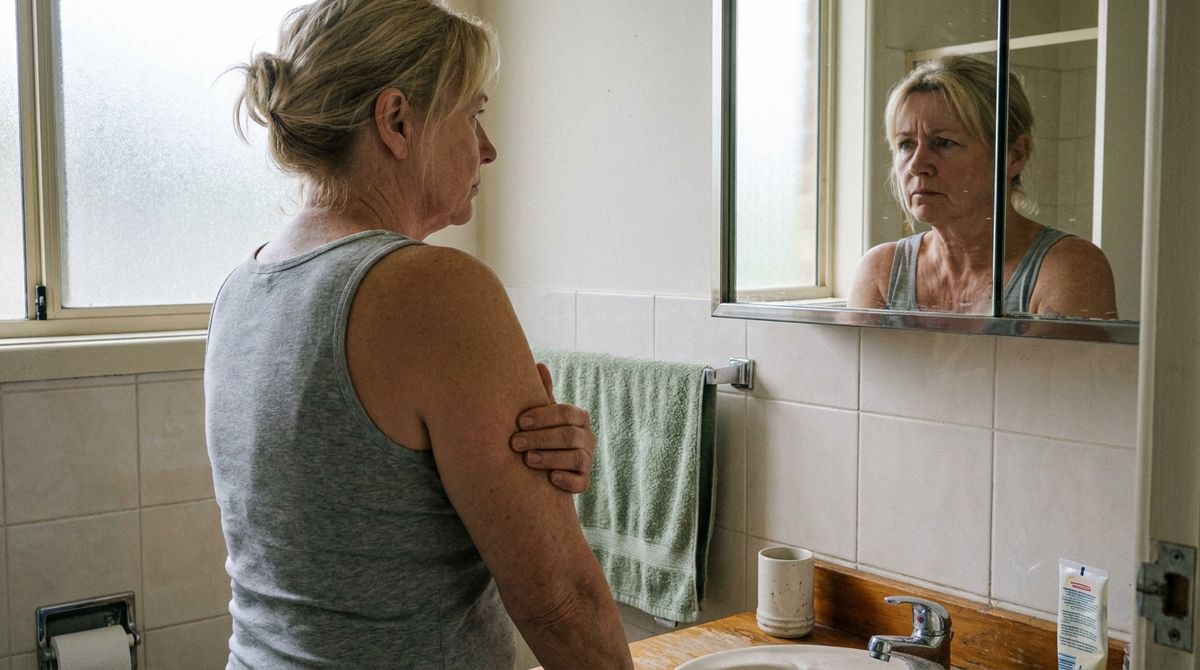
You rub the cream in twice a day. You buy the expensive one. You wait.
And the skin on your upper arms still looks like crinkled paper.
You stopped wearing the sleeveless dress. You stopped raising your hand to wave. You sit in the back of the photo now. Maybe you bought a firming lotion that promised a "lift" and felt nothing change. Maybe you sat in a consult and heard the word "surgery" and walked out.
Here is the part that makes me angry. None of that was your fault. You were handed the wrong instructions.
That is the conclusion Dr. Curtis Okonkwo reached after a 14-month review of his own crepey-skin patients in Spokane, Washington.
"Every woman I saw had done exactly what she was told," he says. "Moisturize. Drink water. And if that fails, cut it out surgically. We were giving them a leaky-bucket fix and blaming them when the bucket stayed empty."
THE INSTRUCTION EVERYONE REPEATS, AND WHY IT FAILS
The standard line is simple. Crepey skin is dry skin. Add moisture, problem solved.
It is wrong, and the failure is obvious if you have tried it. Moisturizer sits on the surface. It feels nice for an afternoon. By the next morning the papery texture is right back.
That is because the texture you hate doesn't live on the surface. It lives in the layer underneath.1
After the hormonal shifts of your fifties, the body slows its production of the structural proteins that gave young skin its bounce, and stops sending the renewal supply to that deep layer almost entirely.2 A moisturizer can't reach it. It was never built to.
"Telling a 58-year-old her crepey arms are a hydration problem," Okonkwo says, "is like telling someone whose house is sinking to repaint the walls."
PICTURE A DELIVERY THAT NEVER ARRIVES
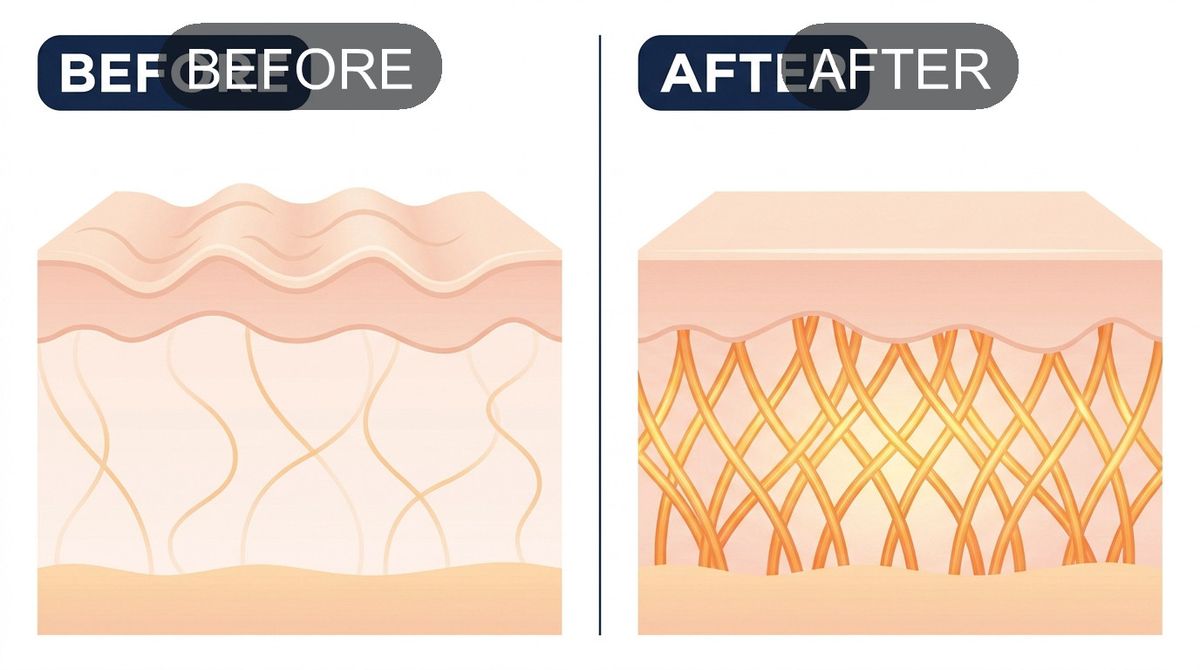
Here is the simplest way Okonkwo explains it to patients.
Think of your skin as having a delivery system. Every day your body is supposed to ship a package, the raw material for firmness, down to the deep foundation layer that holds everything taut.
When you were young, the packages arrived on time, at the right address. The foundation stayed full. The skin sat tight over it.
After menopause, the route breaks down. The package gets the wrong address. It piles up in a backlog at the surface, where it does nothing. The deep layer waits for a delivery that never comes.
So the foundation goes soft. The skin above it has nothing solid to sit on. It bunches and folds into that crinkled, accordion look on the arms, chest, and thighs.
Moisturizer dumps more parcels onto the surface backlog. It never fixes the route. That is the whole problem in one picture.
THE OTHER OPTION COSTS A FORTUNE
If moisturizer is the cheap dead-end, the expensive dead-end is the clinic.
The in-office route runs about $190 a month once you stack the sessions a tech tells you you'll need, and most women are quoted a long course of them. The prestige creams climb past $300 a jar and empty fast over a body-sized area.
And surgery? Thousands of dollars, weeks of recovery, and scars that run the inside of your arm forever.
None of it changes the broken delivery route. You are renting a result. Stop paying and you are back where you started.
That is the trap. Cheap things that don't work, and working-ish things that cost more than most women can keep paying.
What Women Are Actually Being Offered
- Drugstore firming lotions: Surface moisture only, texture returns by morning
- Prestige body creams: $300+ a jar, gone in 3–4 weeks on a body area
- In-clinic sessions: About $190/month, ongoing, stops working when you stop paying
- Arm-lift surgery: Thousands of dollars, weeks of recovery, permanent scars
WHAT THE INVESTIGATION KEPT POINTING TO
Okonkwo wasn't looking for a product. He was looking for a delivery method, something that could re-address the package and get it to the deep layer.
His search kept circling back to one compound the Western beauty industry had almost entirely ignored: Bakuchiol.
It comes from the Babchi plant. For more than three thousand years it sat at the center of East Asian skin rituals, the reason, the old accounts say, that women in those traditions kept firm, smooth skin well into their seventies and eighties.
What sets it apart is what it does. Bakuchiol doesn't sit on the surface and wait. It carries a signal down to the cells that build the structural proteins, and at the same time it blocks the enzymes that break the existing structure down.
In plain terms: it re-routes the delivery. The package finally gets to the right address.
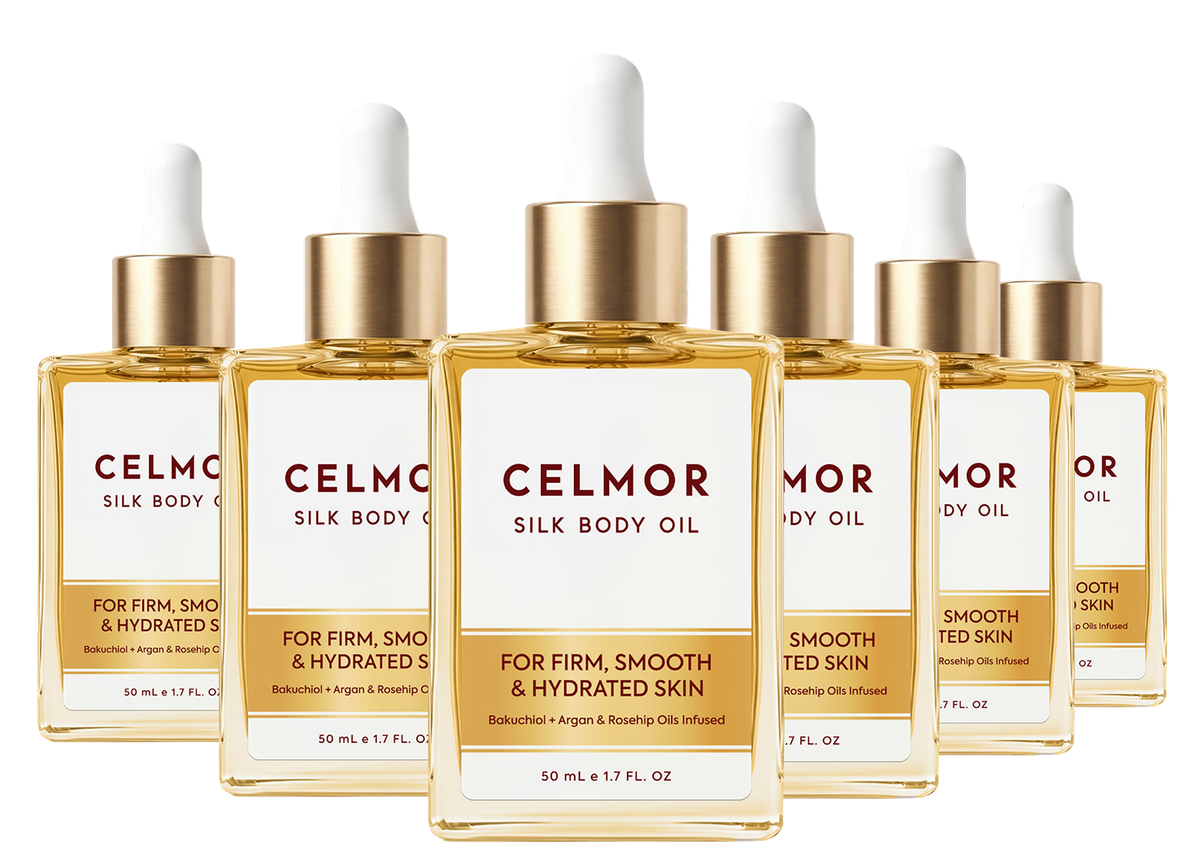
The formulator who had built a body oil around it, pairing the Bakuchiol with jojoba, a carrier the skin recognizes as its own and pulls straight in, had bottled it as CELMOR Silk Body Oil. That is where the investigation landed.
HOW IT ACTUALLY WORKS
The oil is built to do three things in order, fix the route, then send the package, then keep the foundation from collapsing again.
The actives, in plain words:
- Jojoba, a plant oil shaped almost exactly like the oil your own skin makes, so your skin pulls it straight in instead of blocking it. It carries everything else past the surface backlog. No grease, no waiting.
- Bakuchiol, from the Babchi plant, the re-router. It tells the deep cells to start building the structural proteins again, and blocks the enzymes that tear the existing ones down.
- Macadamia oil, one of the few natural sources of a specific fatty acid your skin stops making after 50, in a form skin recognizes, replacing what was lost.
- Rosehip oil, speeds the shedding of the old, damaged surface cells that make skin look papery, clearing the backlog off the top.
- Evening primrose, argan and grape seed, restore flexibility, protect the existing structure, and bind the new fibers into a tighter weave so the result holds.
WHAT WOMEN REPORTED
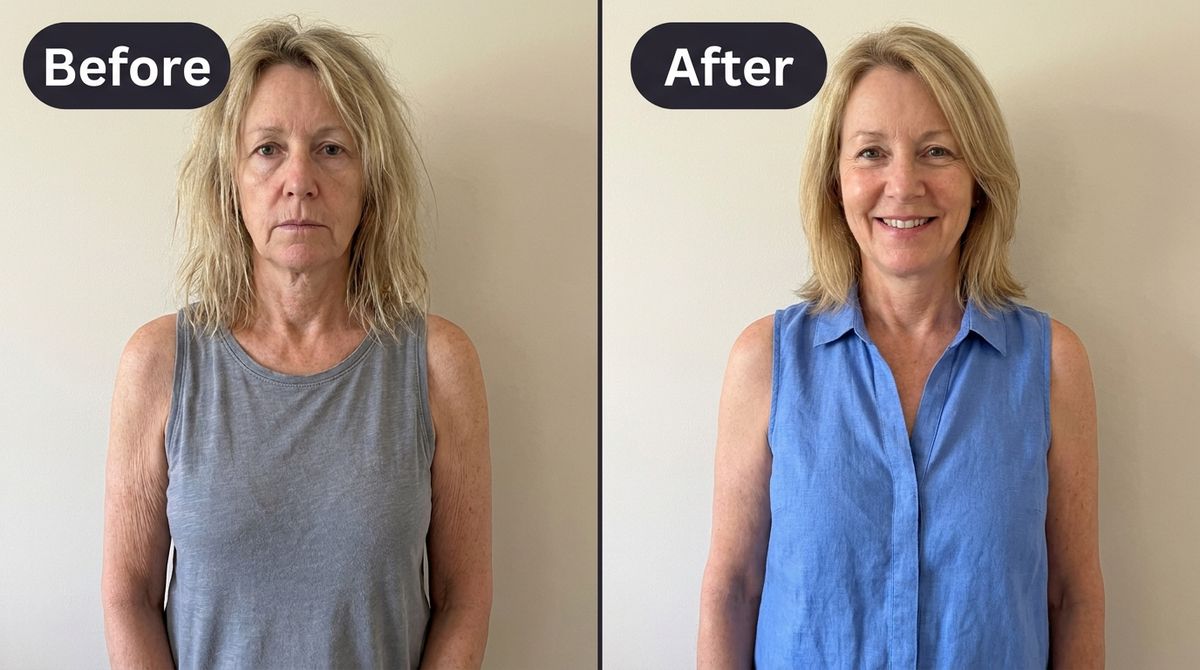
Most women who used it daily said the surface texture eased within the first couple of weeks. The deeper firming, the part that actually changes how the arm looks in a mirror, took longer, generally landing somewhere in the three-to-five-week window with consistent use.
It absorbs in seconds. No film, no grease on the sheets, the complaint that killed every body oil these women tried before.
WHY YOUR DERMATOLOGIST STAYS QUIET
So why isn't every skin clinic talking about this?
Okonkwo is blunt about it. It isn't a conspiracy. It's fear.
The standard crepey-skin protocol, moisturize, then refer to surgery, is the established, defensible position. Deviate from it, recommend something off the script, and if a patient is unhappy you have handed a complaint straight to the board. Sticking to the protocol is how a practice protects itself from liability.
"We don't change the advice because the advice is safe, for us, not for the patient," he says. "Recommending what's standard never gets a doctor in trouble. Recommending what's better might."
A plant oil sold direct to women doesn't fit anywhere in that machine. There's no procedure code, no referral, no risk a clinic is willing to take. So the women never hear about it. They get the leaky bucket.
HOW TO TRY IT
CELMOR is sold direct from the maker, not on Amazon, they say imitation blends have already started showing up there without the Bakuchiol that makes the whole thing work.
One bottle normally runs about $69. Right now, through this page, it's marked down.
You can buy a single bottle, but most women pick the 6-month bundle, it drops the per-bottle price to the lowest tier and it's the one Okonkwo's review group used, because this isn't an overnight thing. The route takes weeks to rebuild and months to hold.
It's backed by a 60-day money-back guarantee, full refund even on a bottle you've already opened and used.
BEFORE YOU CLOSE THIS
It was never your discipline. You followed the instructions perfectly. The instructions were wrong.
The cream couldn't reach the layer that's failing. Nobody told you that, because telling you was a risk your doctor's office wasn't willing to take.
So here's the honest choice. Keep doing the thing that hasn't worked, more cream, more hiding, the same texture next summer. Or fix the route the package travels and give the deep layer the delivery it stopped getting after 50.
Demand has been heavy and the maker batches small. If the page below is still showing stock, it's there. If not, it sold through.
Keep moisturizing harder
Buy the next $80 jar. Rub it in twice a day. Watch the texture come back by morning. Reach for the cardigan in July. Wait for a clinic to quote you $190 a month.
Fix the delivery route
Give the deep layer the collagen signal it stopped getting after 50. Use it daily, give it a few weeks, and judge the mirror, not the marketing, with 60 days to get every dollar back.


REFERENCES
- Internal practice notes, C. Okonkwo, crepey-skin patient review, Spokane WA, 2025–2026.
- Quan T, Fisher GJ. "Role of Age-Associated Alterations of the Dermal Extracellular Matrix Microenvironment in Skin Aging." Gerontology. 2015;61(5):427-434.
- Dhaliwal S, et al. "Prospective, randomized, double-blind assessment of topical bakuchiol and retinol for facial photoaging." British Journal of Dermatology. 2019;180(2):289-296.
- Chaudhuri RK, Bojanowski K. "Bakuchiol: a retinol-like functional compound revealed by gene expression profiling and clinically proven to have anti-aging effects." International Journal of Cosmetic Science. 2014;36(3):221-230.