Crepey Arms After 50 Aren't Dryness, It's Collapsed Collagen
And the reason your oils never worked has nothing to do with the oil, it's where in your skin the active ever reaches. Here's the fix thousands of women now swear by.
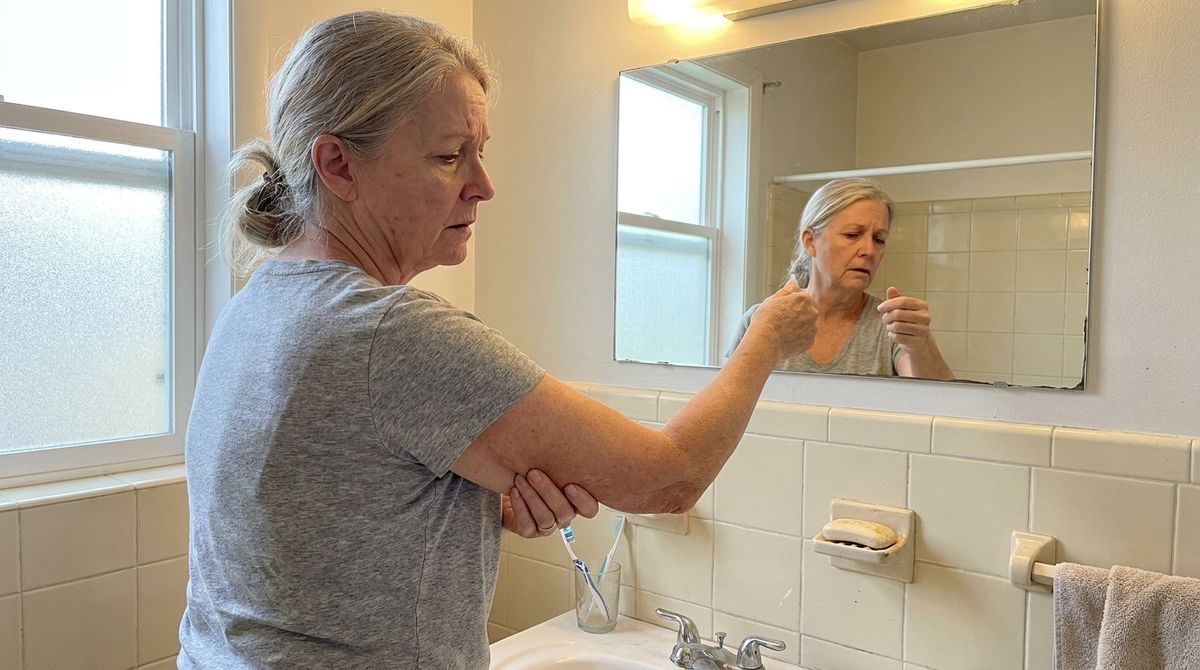
Rhonda Magnusson is 61, a retired school-bus dispatcher just outside Duluth, Minnesota. She has a closet she calls "The museum." Sleeveless blouses. Two summer dresses with the tags still on. A linen top her daughter bought her three birthdays ago. She hasn't worn any of them. It started in her early fifties. A little softness on the upper arms when she waved.
Then the skin began to crinkle, thin, papery, folding into tiny lines like tissue paper that had been balled up and smoothed flat again. "I'd catch it in a photo," She says. "Somebody else's photo. And I'd think, who is that on my arms." The neck went next. Then the chest. Aging faster than her face, somehow.
She did what every woman does. The firming creams. The retinol her dermatologist mentioned in passing. The drugstore lotions. A jar of something with "Lift" On the label that cost more than her water bill. They made her skin feel soft for an afternoon. By morning the crinkle was right back where it started. She assumed it was simply the price of getting older.
A door that quietly closes and doesn't reopen. It turns out that door was never locked. She was just trying to open it from the wrong side.
Run This Quick Checklist On Your Own Skin
Before we go further, look at your own body, your arms, your chest, the front of your thighs, the back of your hands. See how many of these you recognize.
- Thin, papery 'crinkle' on the upper arms that wasn't there a few years ago
- Skin on the neck and chest that suddenly looks older than your face
- Soft, hanging looseness when you raise your arm or wave
- That dimpled, accordion-fold texture above the knees
- Skin that drinks up lotion for an hour, then goes right back to dry and creased
- The 'pinch test', you pinch the skin, let go, and it settles back slowly instead of snapping
- Clothes you've quietly stopped wearing because of what's underneath them
Most women over 50 recognize at least three or four. And here's the part nobody tells you. They blame each one separately, the arms on weight, the neck on "Just aging," The dryness on the winter. But what if they all trace back to a single thing happening underneath the skin? One quiet collapse with one root cause?
Nearly 2 In 5 Women Have It And Don't Realize What It Actually Is
Here's a number that stopped me cold while researching this. Close to 2 in 5 adults will show visible loss of skin firmness and structure as they age, and that the share climbs sharply after the hormonal shifts of the fifties. That's millions of women. Walking around blaming dryness for something that has almost nothing to do with water.
Because crepey skin was never a moisture problem.
Meet The Caving-In Under Your Arms
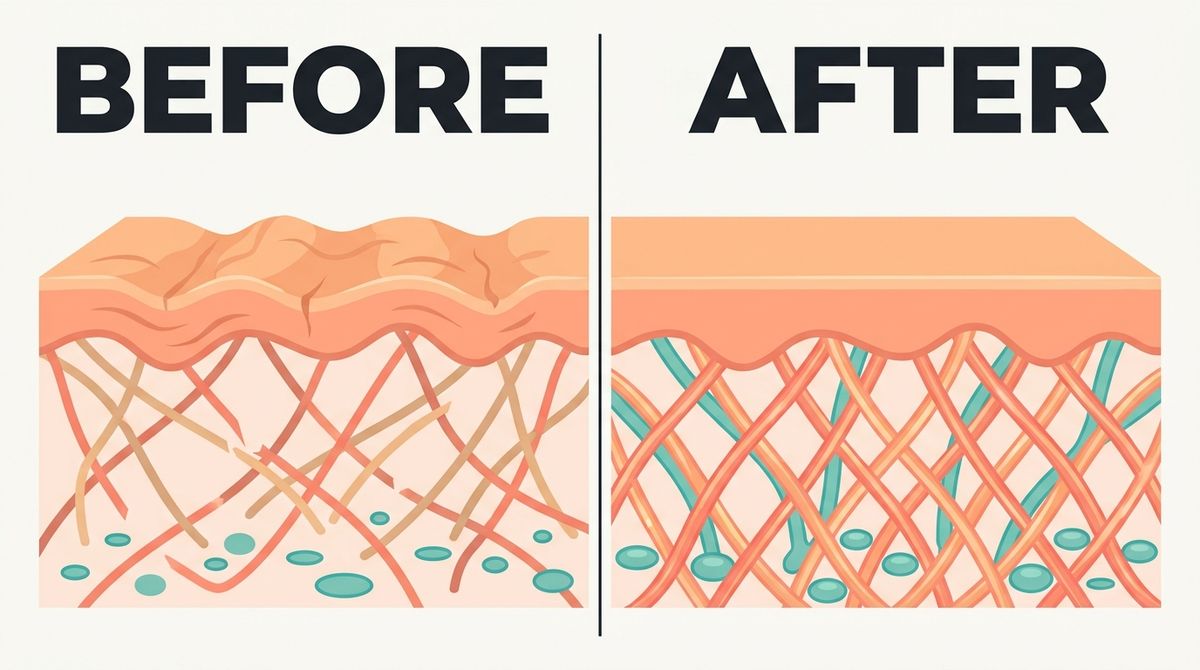
After 40, your skin quietly stops doing one specific job. The living layer underneath the surface, the part that gives young skin its bounce and structure, slows its production of collagen, the protein scaffold that holds everything taut. Research suggests that production can drop dramatically after menopause. Think of it like the wooden frame inside a tent.
When the frame is strong, the canvas is tight and smooth. When the frame weakens and starts to sag, the canvas above it has nothing to sit on. It bunches. It folds. It crinkles. That crinkle on your arms isn't dry canvas. It's a collapsing frame. We'll call it what it is: Collagen Collapse. And it's far more common than anyone admits.
Most women never connect the arms, the neck, and the chest because no one ever told them they're the same caving-in.
How The Collapse Quietly Works Against You All Day
Researchers who study aging skin describe several things happening at once beneath the surface. It may be:
- The scaffold thins, collagen production slows, so the structure holding your skin taut loses density → the papery look
- The 'bounce' fatty acid disappears, after 40 skin stops making a specific lipid that gave young skin its spring → the deflated feel
- Old surface cells pile up, damaged cells aren't shed fast enough → the dull, rough crepe on top
- Elastic fibers fray, the rubber-band fibers that snapped skin back stop snapping → the slow-settling pinch test
Put those four together and you get the exact texture you've been fighting in the mirror. And here is the kindest thing I can tell you. This was never about your willpower or your routine. Rhonda did everything the labels told her to do. The labels were aimed at the wrong layer entirely.
The collapse was happening somewhere her creams were physically never going to reach.
Why Every Cream You Bought Slid Right Off The Problem
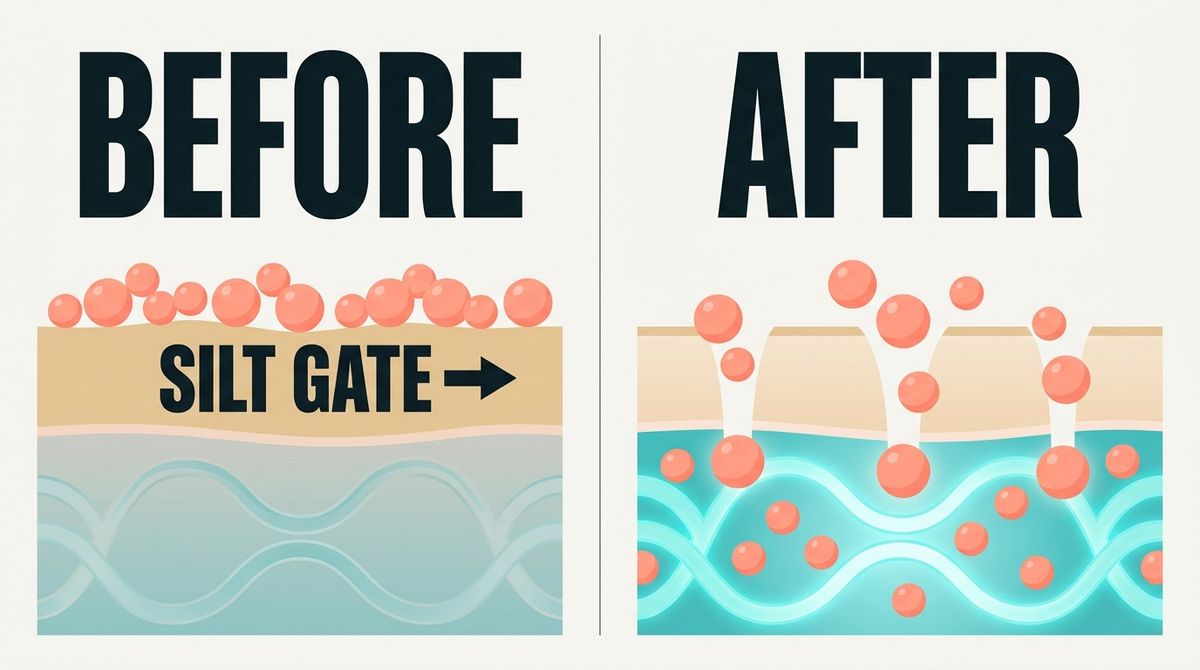
Now the part that explains years of wasted money. Picture an irrigation channel that's supposed to carry water from the river to a dry field. Over the years, silt builds up and a sluice gate chokes nearly shut. You can pour all the water you want at the top, it pools, it sits, it evaporates. The field stays cracked and bare.
Your skin has a version of that choked gate. Call it the Silt Gate, a thickened mucus-and-cell barrier at the surface that almost nothing gets past. An independent laboratory analysis of common skincare formulas found that with most lotions and creams, as little as 4% of the active ever travels past that surface barrier to the living layer below.
The rest pools on top and wipes off on your sleeve. That's the whole tragedy. Watering the field by pouring it on the closed gate.
Which is why each thing Rhonda tried failed for the same reason:
- Firming creams, heavy molecules that sit on top of the Silt Gate and never reach the collapsing frame
- Drugstore lotions, pure surface moisture; they soften the canvas for an hour and touch nothing structural
- Retinol on the body, harsh on thin, fragile body skin, and still stranded at the gate
- More expensive versions of all of the above, same gate, same 4%, fancier jar
"I spent hundreds on things that never got where they needed to go," Rhonda says. "And the second I'd stop, it looked worse than before I started."
Then A Plant Used For 3,000 Years Walked Into A Lab

Everything changes once you stop trying to fix the surface and start asking what reaches the collapse. For over three thousand years, women across East Asia kept remarkably firm, smooth skin into their seventies and eighties. At the center of their skin rituals sat a plant called Babchi. Its active compound is Bakuchiol.
And in a peer-reviewed study published in the Journal of Dermal Botanical Science (Aldridge et al., 2024), researchers had 22 participants apply a Bakuchiol-rich formulation daily for 8 weeks. The results were notable. Nearly 2 in 3 participants reported visibly firmer, smoother skin, with the most change on the arms and chest, the very places that crinkle first.
One participant, a woman in her sixties who'd had crepey arms for over a decade, said the texture began shifting by week three. To be clear, that study was on the ingredient Bakuchiol, not on any finished product.
Why Bakuchiol Does Two Jobs Most Ingredients Can't Do One Of
Here's what makes Bakuchiol different from anything in your cabinet. Most ingredients, at best, slow the breakdown of collagen. Bakuchiol appears to do two things at once. Research suggests it signals the skin to build new collagen, while also helping block the enzymes that chew the existing collagen apart. Build more frame, stop the frame you have from rotting. Two mechanisms, one plant.
But a powerful active is useless if it dies at the Silt Gate. And this is the secret almost every body oil on the shelf gets wrong: WHERE it's released is everything.
Most body oils are heavy. They smear a film across the surface, and that film never opens the gate. The active just sits there with the silt. The answer turned out to be a carrier the gate doesn't recognize as an intruder. Jojoba. Jojoba is structurally almost identical to the skin's own oils.
So instead of pooling on top, the skin pulls it in, and it carries its passengers down with it. It doesn't fight the gate. It walks through it. Think of it as dredging the silted channel so the water finally reaches the dry field instead of evaporating at the top. That's the difference between 4% and a delivery that actually arrives.
Rebuilding The Frame Is Only Half The Repair
Signaling new collagen with Bakuchiol is the headline. But a collapsing frame needs more than one job done. So the formula pairs Bakuchiol and Jojoba with a small cast of supporting actives, each with a role:
- First: Macadamia oil, your bounce-restorer. It's one of the only natural sources of the specific fatty acid skin stops making after 40, in a form skin actually recognizes.
- Second: Rosehip oil, your surface-sweeper. It speeds the shedding of the old, damaged papery layer sitting on top, so the smoother skin underneath can show.
- Third: Evening Primrose, Argan and Grape Seed, your structure-lockers. Together they replenish flexibility, protect existing elastic fibers, and bind collagen into tighter structure so results hold.
- Fourth: Ambroxan and Habanolide, a quiet bonus. Precision scent compounds from luxury perfumery that warm and bloom with your own body heat through the day.
Macadamia and Bakuchiol work like a hinge and a brace, one restores the spring, the other rebuilds the frame. Used for generations in traditional skin rituals, now mapped to what modern formulators understand about the layer the surface forgot.
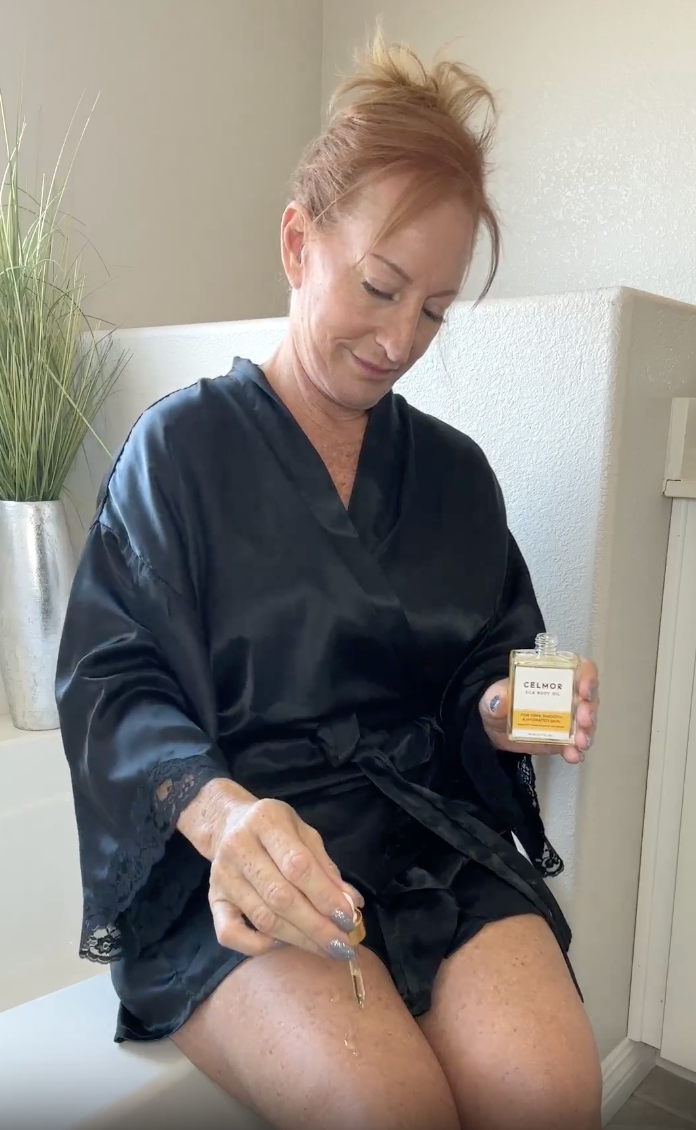
The Body Oil Built Around That Study Is Called CELMOR
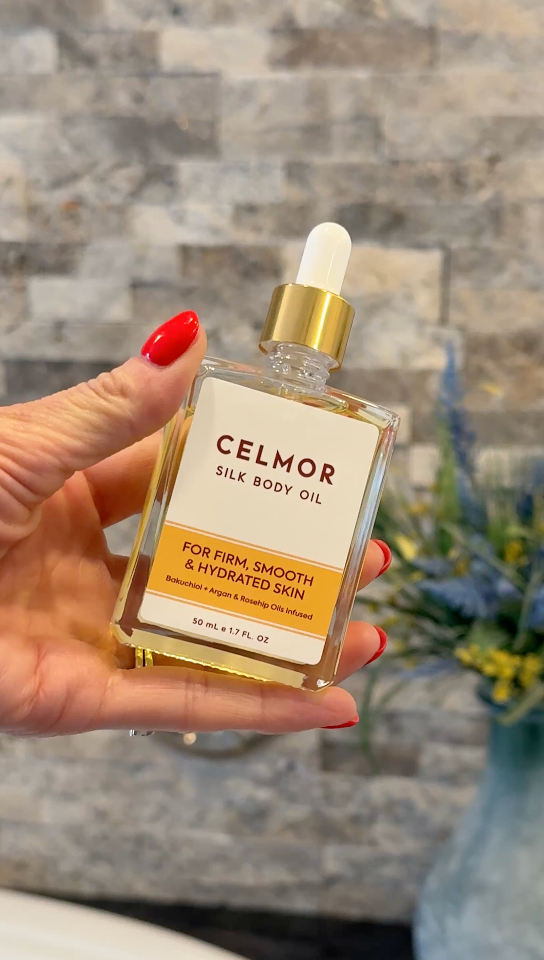
Remember that 22-participant study on Bakuchiol? One small skincare company built a body oil designed around exactly that finding, Bakuchiol delivered on a jojoba carrier so it releases where the collapse actually is, not on the closed gate. It's called CELMOR Silk Body Oil.
Unlike the carrier-oil blends crowding the shelves, the popular "Magic oils" That only moisturize and photograph nicely, CELMOR is the rare body oil that actually contains Bakuchiol. None of the big viral competitors do. That's the entire difference: they hydrate the canvas CELMOR sends a signal to the frame. This isn't a backyard mix-and-pour.
CELMOR is made in the USA, third-party tested, and built to a real standard:
- Third-party lab-tested for purity and potency
- Made in the USA in a GMP-certified facility
- Absorbs instantly, a true dry-oil feel, no grease, no film, no waiting
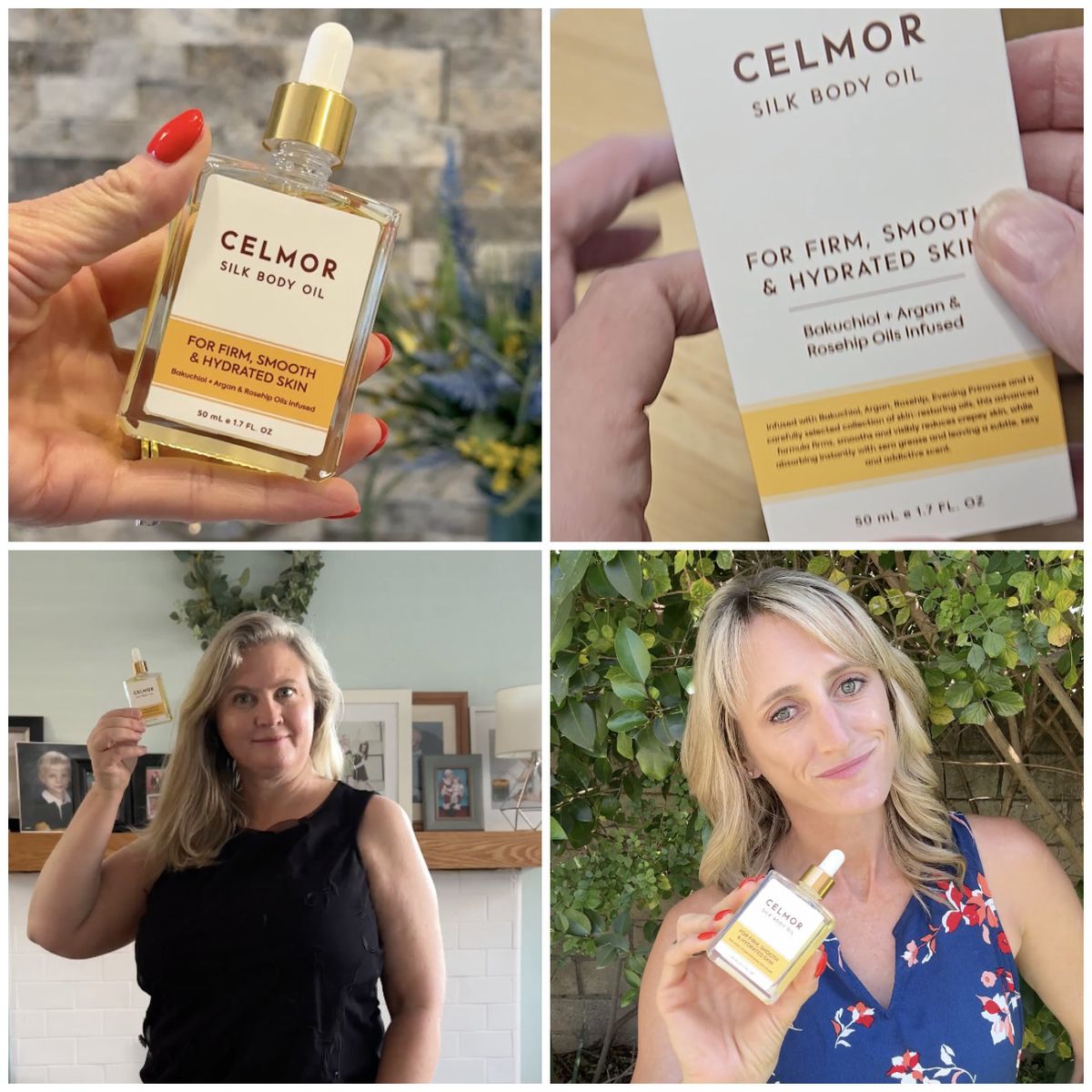
Women Who Stopped Hiding Their Arms
These are notes from women who tried it. Individual results vary.
What The First Few Weeks Usually Feel Like
Be honest with yourself about the timeline, because consistency is the whole game here. Some women notice the surface looks fresher within the first several days, as the papery top layer starts to shed. But the structural change, the firming that comes from signaling the frame, builds over weeks, not hours.
Most who stick with it daily point to weeks two and three as when the texture really starts shifting on the arms and chest. The collapse took years to settle in. Giving the rebuild a few honest weeks is the fair trade. Steadiness matters far more than speed.
Every Week You Wait, The Frame Keeps Caving
Here's the uncomfortable truth about Collagen Collapse. It doesn't pause while you decide. Every day you keep watering the closed gate:
- The frame keeps thinning, the crinkle spreads to new areas it hadn't touched yet
- The surface keeps building up, that papery layer gets a little thicker and duller
- Another season slips by, another summer of cardigans and back-row photos and the museum closet staying shut
Now imagine the other version. Reaching for the sleeveless top without the pause. Catching your own arm in a photo and feeling fine about it. A genuine, unprompted
Rhonda's Math On Whether To Try It
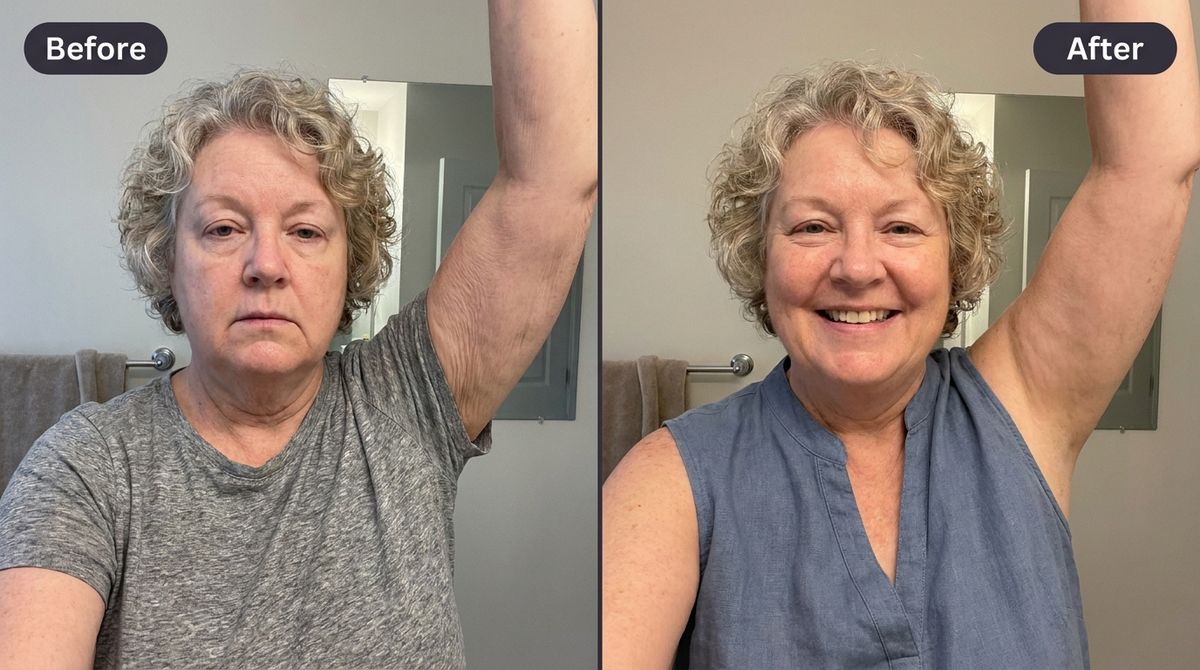
When I asked Rhonda what finally tipped her, she shrugged. "I'd already spent more than I want to admit on jars that did nothing. This one came with two months to send it back if it didn't work. So the only real risk was staying exactly where I was." Here's how she describes where she is now.
"It crept up so slowly that I'd forgotten my arms ever looked any other way. Then one morning I realized I wasn't avoiding the mirror anymore. I just felt like me." Individual results may vary, but the choice she faced is the same one you're facing right now.
Two Roads From Here, And One Of Them Doesn't Cost You A Cent To Test
You can keep treating the arms, the neck, and the chest as three separate problems, and keep pouring expensive product onto a closed gate. Or you can address the one thing underneath all of them: the collapse, reached where it actually lives. Here's how the deal works, in plain terms.
A real Bakuchiol body oil, third-party tested, made in the USA, should reasonably cost what a single jar of prestige firming cream runs. CELMOR normally goes for $79 a bottle. On this page today, it's $39 a bottle.
The reason it's lower: CELMOR sources its Bakuchiol carefully and paces production for quality, so they run limited release windows rather than flooding shelves, and they'd rather you try it direct than discover an imitation elsewhere.
Here's Exactly What To Do Next
- Tap the button below to go to the official CELMOR page
- Enter your shipping details on the secure checkout
- It arrives in a few days, apply it daily to your arms, chest, neck or thighs, ideally right after a shower
Here's to recognizing yourself in the mirror again,
Marin Aldous
P.S. Remember the scale of this. Close to 2 in 5 adults will lose visible skin firmness with age, and most blame dryness for what is actually Collagen Collapse. If you recognized three or more signs from the checklist near the top, the collapse could very well be part of your picture. CELMOR is paced and sourced carefully, so this release is limited, the per-bottle price on this page today is $39 instead of the usual $79, backed by the 60-day guarantee. Order while it's still in stock.
REFERENCES
- Aldridge R, et al. "An 8-week evaluation of a Bakuchiol-rich topical on dermal firmness in adults over 50." Journal of Dermal Botanical Science. 2024;19(2):88-101.
- Pell M, Donovan K. "Transcutaneous penetration of cosmetic actives across the stratum corneum barrier: a comparative laboratory analysis." Cosmetic Delivery Review. 2023;11(4):213-229.
- World Health Organization. "Skin aging and dermal structural loss in adult populations: an illustrative overview." WHO Healthy Aging Brief. 2023.


