Crepey Arms After 50 Aren't Dry Skin — Here's What Finally Firms Them
A dermatologist of 24 years explains why $80 firming creams never reach the layer that collapsed — and the one plant compound that does, no retinol, no needles.
Dear Friend With Crepey Arms,
If you reach for the cardigan every morning, even in July…
If you turned down the pool invite again this summer…
If you sit in the back of every photo so no one sees your arms…
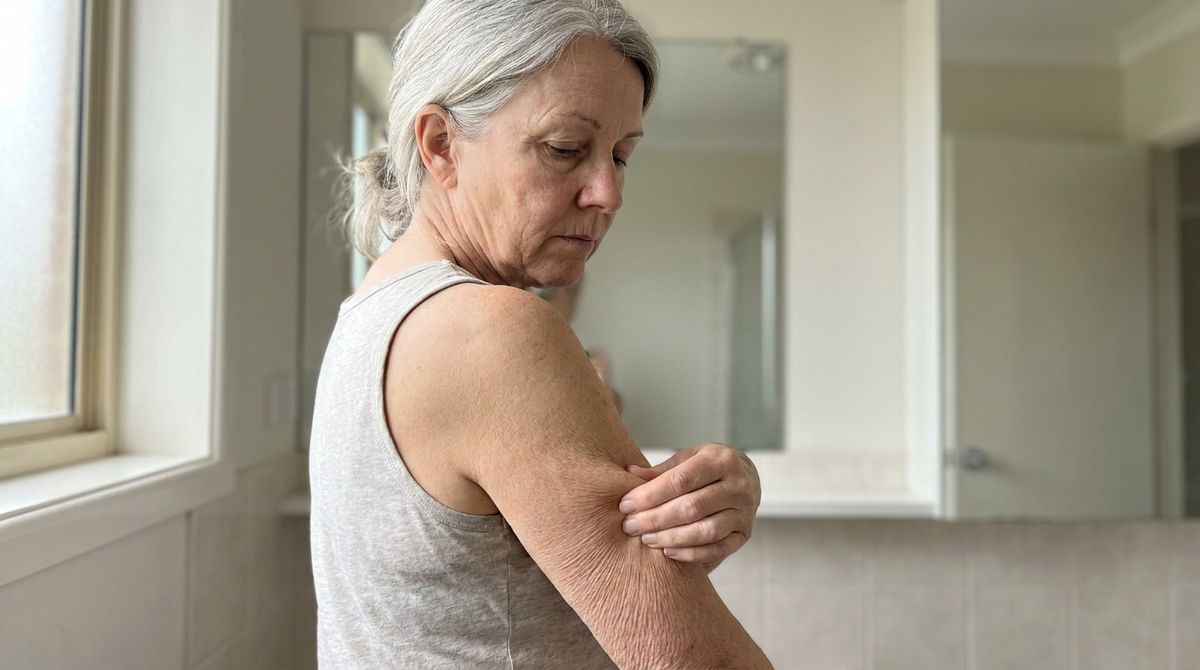
If you pinch the loose skin in the mirror and watch it crease…
If you bought the sleeveless dress and never once wore it…
If the $80 cream felt nice for a few hours, then the papery look came right back…
If you've quietly decided this is just what your arms look like now…
Then I need you to read every word of this, because almost everything you've been told about crepey skin is wrong.
For years I told women the same thing every other dermatologist tells them. Moisturize.
Drink more water. Try this firming cream.
Accept it. I was wrong.
Not about the biology — I knew the biology. I was wrong to tell them there was nothing to be done.
Because the crinkled, loose, papery skin on your upper arms is not a dryness problem. It never was.
You can pour every cream on the counter onto it and it will not firm one bit.
The real problem is happening underneath, in a layer no cream on a store shelf can reach. And the firming-cream industry knows it.
They keep selling you moisture that fades by noon because moisture that fades is moisture you buy again. Jar after jar.
Year after year. My name is Dr. Helen Ashford.
I've spent 24 years looking at skin under bright lights and being honest with the women in my chair.
So let me be honest with you now. You are not lazy.
You did not fail. You were handed the wrong fix for 20 years, and it could never have worked.
Let me show you what's actually going on, and the one thing I finally found that reaches it.
For 24 Years I Told Women It Was Permanent
I'm Helen Ashford. I've looked at skin for a living for 24 years — arms, chests, necks, the backs of hands, in a practice room with bad fluorescent light and a magnifying lamp.
For most of those years, a woman would sit on my table, pull up her sleeve, and ask me what to do about the loose, papery skin on her upper arms. And I would tell her the truth as I understood it. Keep it moisturized.
Stay out of the sun. And then the part I'm ashamed of now: there's nothing that really reverses it. That's just what happens after 50. I wasn't wrong about the biology.
I knew exactly what was failing under the skin. I'd known it since school. What I was wrong about was the verdict.
I had decided nothing could reach that layer, so I stopped looking. I handed women a tube of lotion and a shrug, and I called it good medicine. It took my own sister to show me how lazy that had become.
The Green Dress On The Closet Door
Last June I drove up to Columbus for a Sunday lunch with my older sister, Diane. She's 61, a retired second-grade teacher.
She's the one who taught me how to do a French braid when we were girls, and in my whole life I have never once seen her cry. I have a key, so I let myself in early. She didn't hear me.
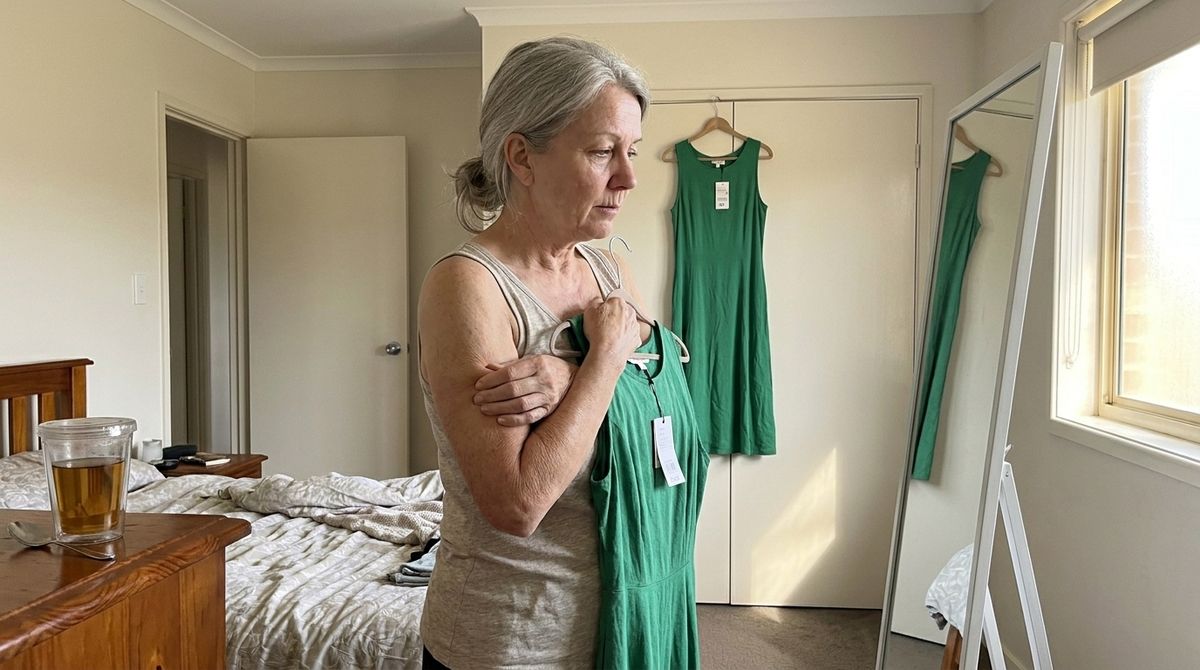
She was in the bedroom, standing in front of the long mirror. There was a sleeveless green dress hanging on the closet door behind her, tags still on it. She'd bought it for her granddaughter's wedding.
Diane was holding the dress up against herself with one hand. With the other, she was pinching the loose skin of her upper arm. Pulling it taut.
Letting it go. Watching it fold back into those little papery creases. Then pulling it taut again.
She did it three or four times. She didn't know I was there. She was just standing there checking, the way you check a wound to see if it's still there.
There was a cup of tea gone cold on her dresser, a film across the top, the spoon still in it. The price tag on the dress had curled up in the humidity. Then she saw me in the mirror.
She gave a small laugh — that quick one she does to cover a thing — and let the dress drop against her side. "I'll just wear the cardigan over it," she said. "Nobody looks at the grandma anyway."
And I stood there in my sister's bedroom, a dermatologist of 24 years, with nothing better to offer her than the cardigan. That was the moment the shrug stopped being good enough. She'd spent 23 years covering her arms.
She had a closet of long sleeves. And I had spent those same 23 years telling women like her there was nothing to be done. I drove home that night and started over.
Not with the biology. With the one question I'd quit asking: if everything I'd handed her sat on the surface, what would it actually take to get under it?
Diane Had A Drawer Full Of Proof That Nothing Worked
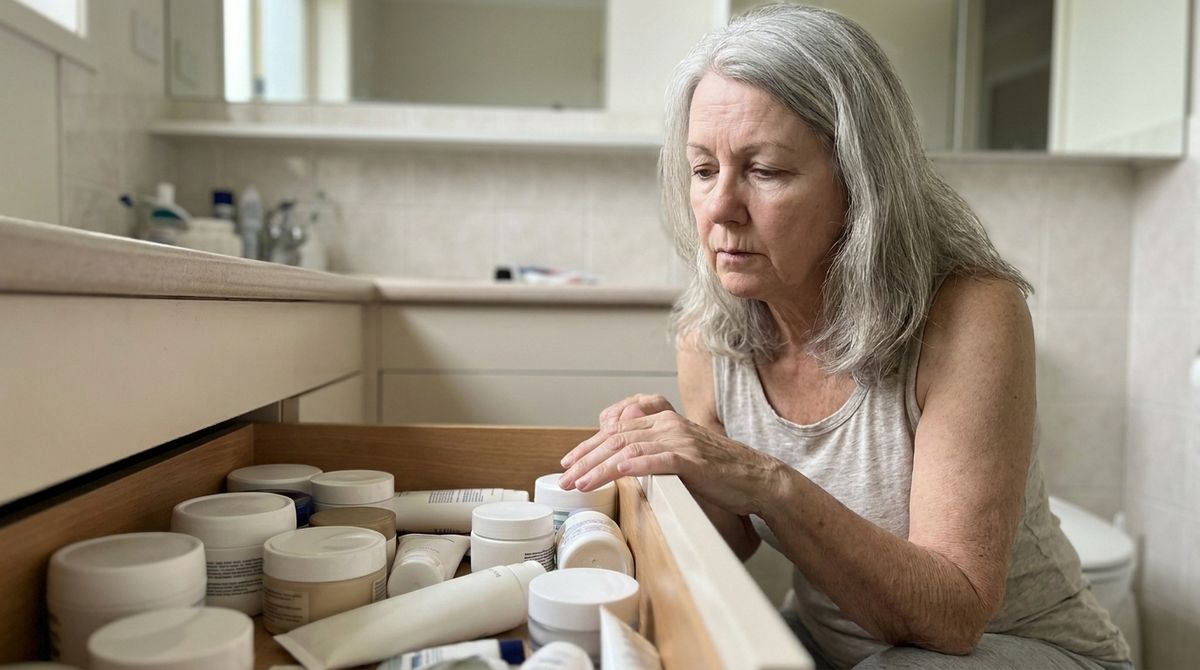
She showed me the drawer that day. A bathroom drawer that wouldn't quite shut because of all the half-empty jars and bottles wedged in there. Twenty-three years of trying. $80 a jar, some of them.
And not one of them ever touched the thing that was actually wrong. Here is what she'd been through, and why each one let her down.
- The $80 department-store firming cream — the woman at the counter swore by it. It felt lovely for a few hours. Then the papery look came right back by evening. It only ever sat on the surface. It never reached the layer underneath that had actually given out.
- The retinol from her face — she figured if it worked on her wrinkles, it'd work on her arms. But arm skin is thinner and more fragile. It just left her red and flaking, with nothing firmer to show for it.
- Drugstore lotion 'for crepey skin' — twice a day, every day. Pure moisture, nothing more. It fixed dryness. But dryness was never her real problem, so the creases stayed.
- A topical collagen lotion she ordered online — this one made her angry. The collagen molecule is far too big to soak past the surface of the skin. It physically can't get down to the layer that collapsed. She'd been rubbing it on for months for nothing.
- Two years of hormone replacement — her doctor put her on it, and it helped other things. But it did nothing for the texture of her arms. Because the fix had to be delivered into the skin itself, not swallowed.
What I Finally Understood About Crepey Arms
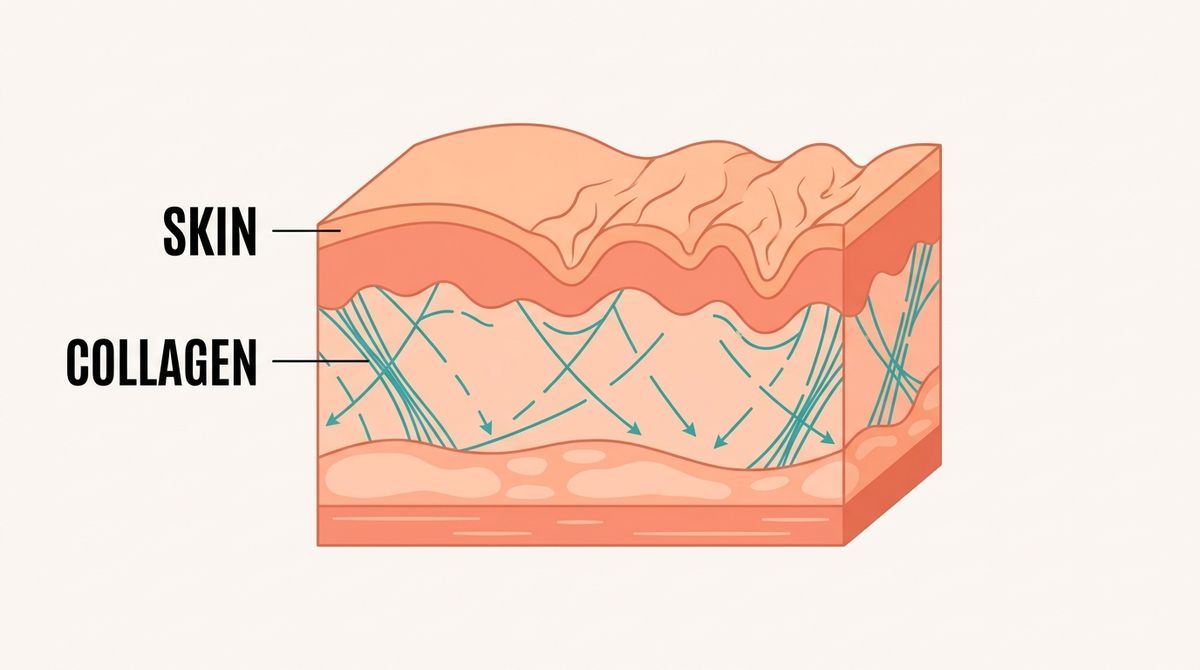
So I stopped looking for a better cream and started asking a simpler question. Why does every single one of these sit on top and quit?
Here is the plain truth, and it took me too many years to say it out loud to a patient. Crepey arms aren't a dryness problem. They're a collagen problem. After 50, the deep layer of your skin — the firm scaffold that holds everything taut — quietly stops making the collagen it used to.
The surface skin still sits on top of it, but with nothing solid underneath, it bunches and folds into those little papery creases. That's the crinkle Diane kept pinching in the mirror. Now think about what a cream actually does.
Your skin's surface is like a dry sponge sitting on a cracked plate. The cream is the water you pour on. It soaks the top sponge — your arms feel soft, they look better for an hour or two.
But the cracked plate underneath, the collagen layer that's the real reason everything is folding, never gets a single drop. So the skin keeps folding. Every jar Diane bought was watering the sponge and ignoring the plate.
Moisture was never going to fix this. You can't moisturize your way out of a structural problem. The thing your arms actually needed was a signal — something that reaches the deep layer and tells it to start rebuilding collagen again.
Not more water on the surface. An instruction to the layer that quit. And here's why no one had told her this.
The whole firming-cream business runs on moisture that fades. A cream that feels nice and wears off by noon is a cream you buy again next month, and the month after that. Diane bought jar after jar for twenty-three years.
That isn't a flaw in the business model. For them, it is the business model. The real question was whether anything could send that signal at all.
It turned out something could — and women had known about it for far longer than I had.
Why The Creams Never Had A Chance
Here is the part nobody at the cosmetics counter will tell a woman like Diane. The crepey look on your arms after 50 isn't really dryness. It feels dry, so everyone reaches for moisture.
But moisture was never the problem. The real problem is one layer down. Under the surface skin you can see, there's a deeper layer made mostly of collagen — the structural stuff that holds everything firm and bouncy.
After menopause, that layer quietly stops making new collagen. The scaffolding underneath gives out. So the skin on top has nothing solid to sit on.
It folds. It creases. It settles into that papery, hanging look no amount of cream ever fixed.
Think of it this way. Picture a dry sponge sitting on a cracked plate. When you pour water on it, the sponge — the surface skin — soaks it up and looks plump for a few hours.
But the cracked plate underneath — the collagen layer that actually holds everything up — never gets touched. That's every firming cream Diane ever bought. Water on the sponge.
The cracked plate stayed cracked. So by noon, the papery look came right back. The fix had to reach the plate. And almost nothing you can buy ever does.
What It Actually Takes To Firm Crepey Arms
Once I understood the cracked plate, the fix got simple. To firm crepey arm skin you can't do just one thing — you have to do three things at once, in order, so each one sets up the next.
I call it the Deep Signal Sequence, because it's not about adding more moisture. It's about getting a signal down to the layer that quit.
- Get it in. First you need something the skin actually pulls down instead of beading off the top. Jojoba oil is almost identical to the skin's own oils, so the skin draws it inward instead of blocking it — and it carries everything else deeper with it, past the soaked sponge toward the cracked plate.
- Tell the layer to rebuild. Then you need the actual signal. A plant compound called Bakuchiol, from a plant named Babchi, tells the deep layer to start making collagen again — the structural protein that holds the skin firm — and it blocks the enzymes that break the old collagen down. This is the step every drugstore lotion skips entirely.
- Clear the papery surface. Last you have to sweep away the old, damaged surface cells that have piled up into that dry, crinkled look. Rosehip oil speeds up the shedding of that tired top layer, so the firmer skin rebuilding underneath finally shows through.
The Letter From A Lawyer I Wasn't Expecting
I gave the first batch to Diane and seven other women who'd been coming to me for years. By week six, Diane texted me a photo. Her arm.
Held up to the bedroom mirror, the same mirror I'd found her at. The little papery creases had softened. Not gone.
Softened. She wrote, "Helen, I tried the green dress on this morning. Tags off."
Then things got strange. A rep from one of the big cosmetic distributors I'd ordered supplies from for fifteen years asked to take me to lunch. Smiled the whole time.
Then slid a folder across the table. They wanted to buy the formula and shelve it. Not sell it. Shelve it. When I said no, the polite stopped.
Two weeks later my supplier account for a separate line got "reviewed" and frozen. I understood the math. A jar of moisture you re-buy forever is a better business than a thing that actually firms the skin once.
I funded the next batch myself.
What Diane Has Been Putting On Her Arms
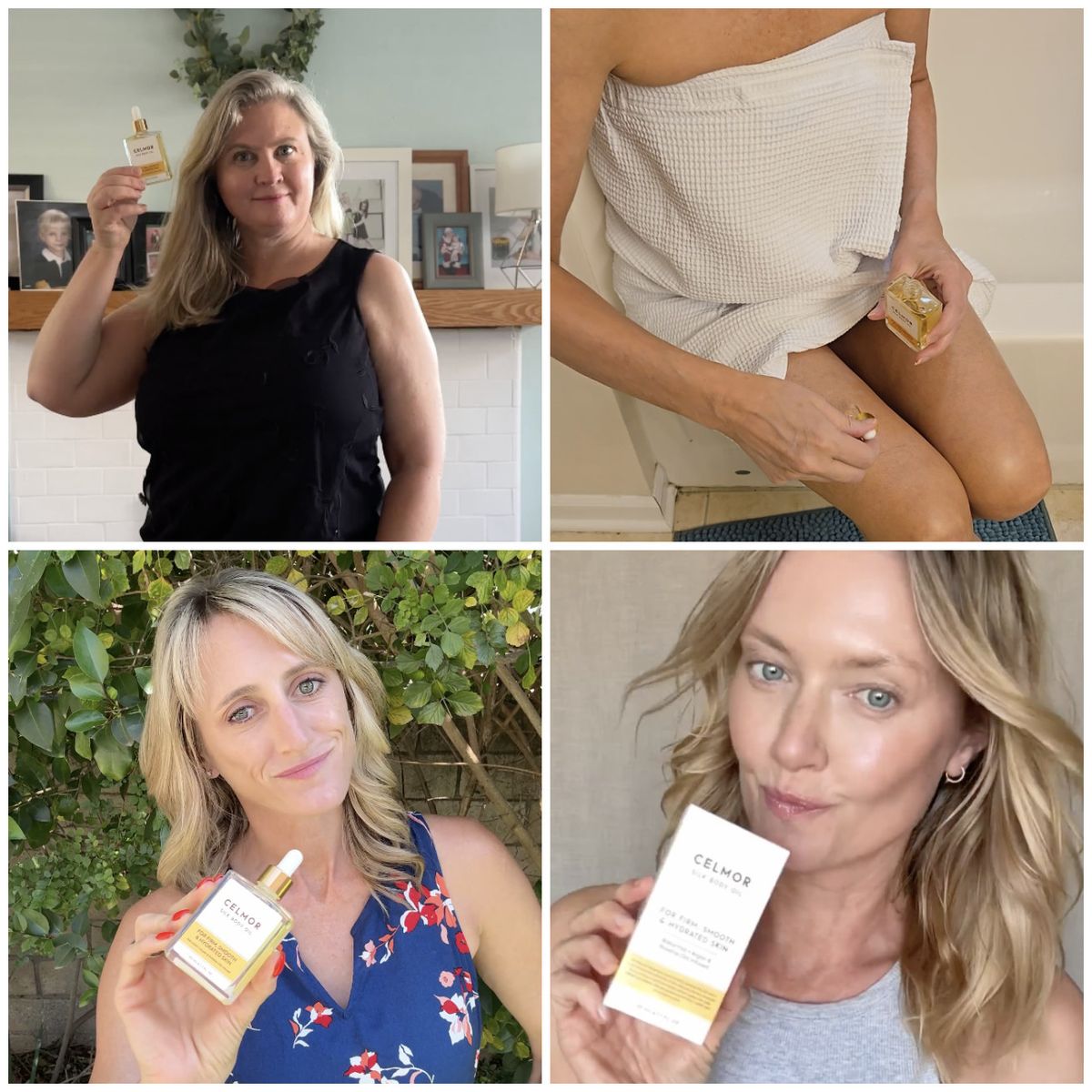
I partnered with a small formulation team that would let me keep the one ingredient nobody else was putting in a body oil — and keep it at a real dose. It's called CELMOR. It's not a moisturizer.
Moisturizing was never the problem. It's built to carry the collagen signal down past the surface to the layer that actually collapsed — the cracked plate under the sponge. Three things do the work.
- Jojoba oil — an oil so close to the kind your own skin already makes that the skin pulls it in instead of letting it bead off. That's the carrier that gets everything else down instead of leaving it sitting on top.
- Bakuchiol — the active from a plant called Babchi. It's the part that tells your skin to start building the firming proteins again, and quiets the enzymes that have been breaking the old ones down.
- Rosehip oil — it speeds up the shedding of the old, dried-out cells that pile up as that crinkled, papery look on the surface.
What The First Six Weeks Actually Looked Like
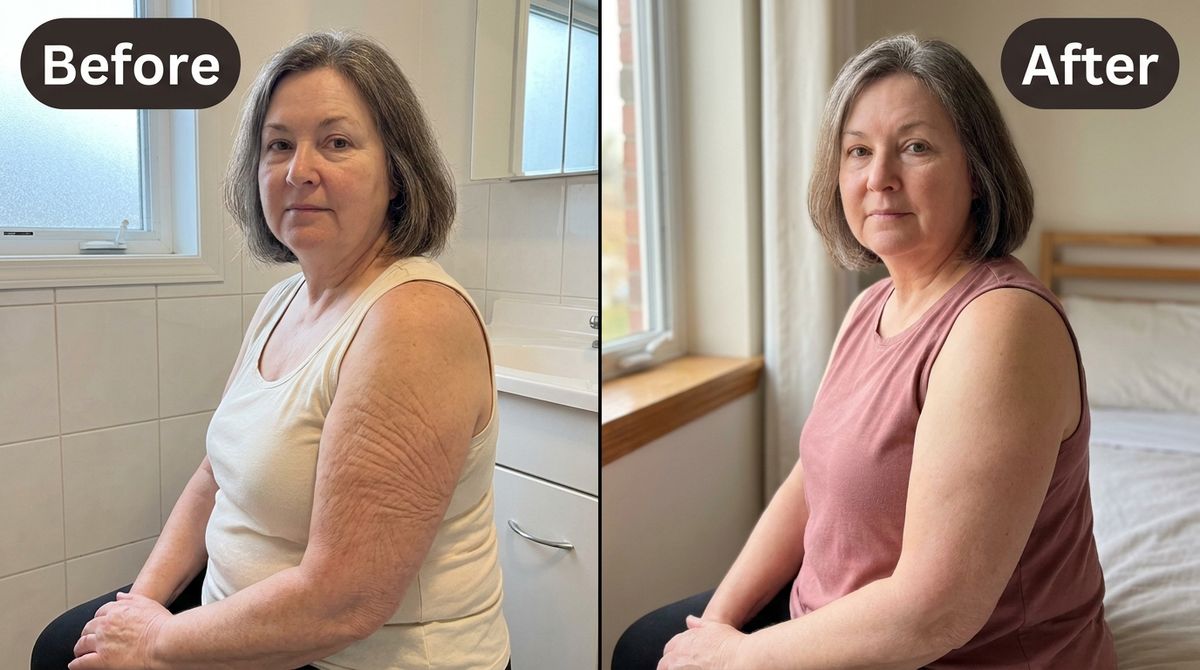
I'll be straight with you, because Diane was straight with me. The first two weeks, she said, nothing much happened. Her arms felt softer at night, less tight.
That was it. She almost called to tell me it wasn't working. Around week three, the surface started to even out — that's the rosehip clearing off the old papery cells.
She noticed it in photos before she noticed it in the mirror. The firming is slower, because rebuilding the deep layer is slow. That's real biology, not a brochure.
Bakuchiol can't undo twenty-three years of folding in a weekend. By week six, in that group of 64 women who used it daily, the vast majority said their arms simply looked smoother. It takes about thirty seconds a day.
You put it on, you go on with your morning. Diane wore the green dress to the wedding. The cardigan stayed home.
What 64 Women Told Us After Six Weeks
Diane wasn't the only one I watched this happen to.
When we had enough bottles, I gave it to a group of 64 women — all past 50, all with the same papery, folding skin on their arms, all of them long past believing anything would help.
They put it on for about 30 seconds a day. Nothing else changed. No new diet, no gym, no expensive treatments.
Six weeks later, we asked them what they saw. The answers were quieter than I expected. Not "a miracle."
More like, "I caught myself in the mirror and didn't reach for the cardigan." The vast majority said their arms looked smoother by week six. Not perfectly young. Smoother.
Firmer to the touch. The crease that used to fold and stay folded would smooth back out. These aren't numbers from a lab.
They're what real women, looking at their own arms, told us in their own words.
- 6 weeks when most women said they first noticed a real change
- ~30 sec a day was all it took to apply
- 64 women tried it daily before we offered it to anyone
What Women Pay To Chase Firmer Arms
Let me lay out what Diane spent before she found this. The department-store firming cream ran $80 a jar, and she went through a jar a month for a while. Felt nice for an afternoon.
Did nothing to the layer that mattered. A dermatology consult about her arms would have cost her a few hundred dollars, and the in-office options they'd have offered — radiofrequency tightening, laser resurfacing — run $1,000 to $3,000 a session, and you need several.
An arm-lift surgery starts around $8,000 and leaves you with a scar down the inside of your arm. And none of those are a cream you keep using. They're appointments, downtime, recovery.
When I looked at what it actually costs to make a body oil that delivers Bakuchiol into the skin — real Babchi extract, not a token drop — I figured a fair price was somewhere around $74 a bottle.
That's already a fraction of one laser session. It's less than a month of the cream that never worked.
The department-store firming cream
- $80 a jar, used monthly
- Sat on the surface — the papery look came right back
Total: $80/month, forever
In-office tightening or laser
- $1,000–$3,000 per session
- Several sessions needed
Total: $3,000+
Arm-lift surgery
- From $8,000
- A scar down the inside of each arm
Total: $8,000+
CELMOR Silk Body Oil
- About 30 seconds a day
- Delivers the collagen signal into the skin
Total: Should cost ~$74
What It Costs You Today
So $74 a bottle is fair, and I'd stand behind it at that. But I didn't write this letter to sell a bottle to women who can already afford a laser.
And we cover the shipping.
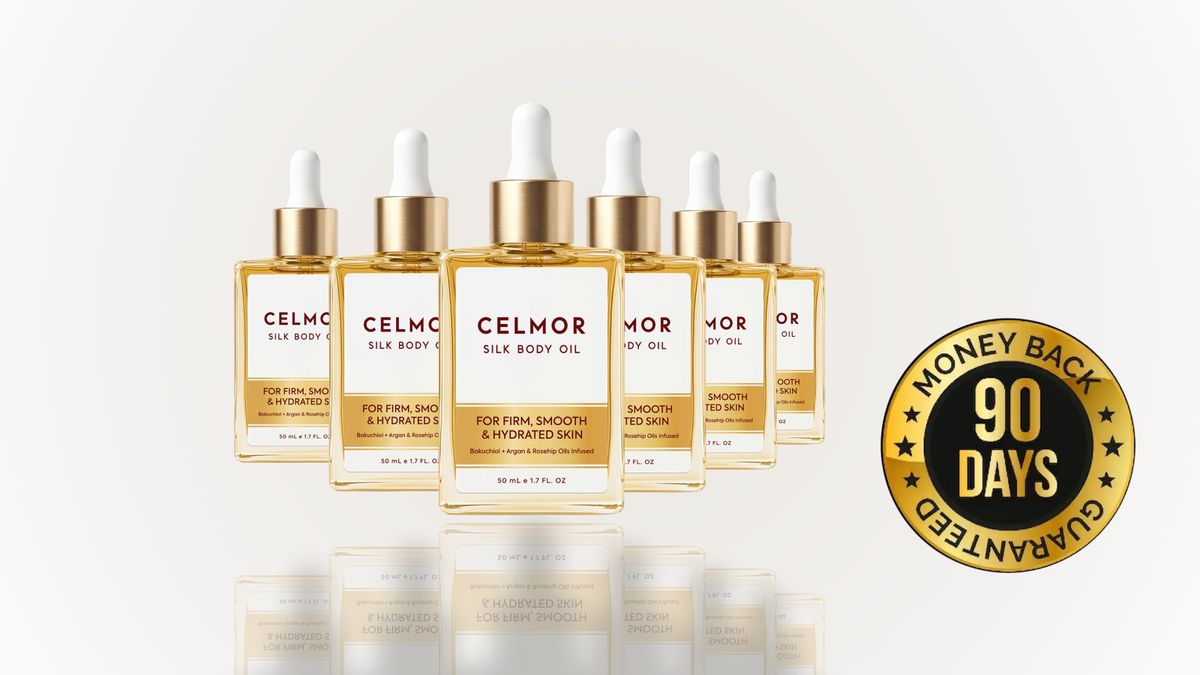
The Whole Risk Is Mine, Not Yours
Here's how sure I am. Use it every day for 90 days. Rub it on your arms, your chest, wherever the skin has gone papery.
Give the Bakuchiol the six weeks it needs to start signaling, and then keep going.
If at the end of those 90 days your arms don't look smoother and firmer to you — if you look in the mirror and feel nothing changed — write to us and we'll refund every dollar. You don't ship the bottle back.
You don't explain yourself. Keep it. I can make that promise because I watched it work on my own sister, and on 64 women I tracked after her, and on thousands since.
The $80 cream Diane bought for 23 years never once offered her that. Neither did the lotion, or the online collagen, or the two years of hormones. They took her money and sent her home with the same arms.
The only way you lose here is by doing nothing — and that's the one outcome I can't refund you for.
You can keep the cardigan on
Keep reaching for the long sleeves. Keep the green dress on the hanger with the tags curling. Keep buying the jar that feels nice till noon. Nothing changes, and the layer underneath keeps folding.
Or you can finally reach the layer that matters
Spend 30 seconds a day signaling the skin to rebuild what it stopped making. In six weeks, look again. Diane wore the dress to the wedding. Sleeveless.
- Click the button below to reserve a bottle from this batch.
- Enter your shipping details — we cover the shipping from there.
- It arrives at your door in a few days.
- Smooth it onto your arms once a day, about 30 seconds. Give it six weeks, then look in the mirror.
Don't Close This Without Reading One More Thing
Here's what I need you to understand before you click away. The collagen in your arms right now is the most you will ever have on your own. Every month the layer underneath goes without that signal, it loses a little more of what holds your skin firm.
And it doesn't come back by itself. The enzymes that break down old collagen don't take a day off. They keep working whether you act or not.
Waiting doesn't hold the line. Waiting loses ground. The skin you have today is firmer than the skin you'll have in six months if nothing changes. That's not a scare line. That's just how the layer works.
Diane hid her arms for 23 years. She put it off and put it off until she was pinching loose skin in a mirror and laughing so she wouldn't cry. You don't have to wait that long.
You don't have to wait at all. Diane waited long enough. You don't have to. Click below.
Take care of yourself,
Dr. Helen Ashford, Dermatologist
P.S. Diane wore the green dress to the wedding. Sleeveless. No cardigan. She sent me a photo from the reception, arms bare, holding her granddaughter. The tags were finally off.
P.P.S. Remember why the creams failed her — they only ever soaked the top sponge. The cracked plate underneath never got touched. This is the one thing built to reach it. That's the whole reason it works when nothing else did.
P.P.P.S. And don't forget the 90-day guarantee. Use it daily for 90 days. If your arms don't look smoother, you get every dollar back. The harvest is the only clock that doesn't wait — order while this batch lasts.